 An official website of the United States government
Out-of-Pocket Spending on Complementary Health Approaches in the U.S.
Total Health Care Spending, 2012
$2.82 trillion
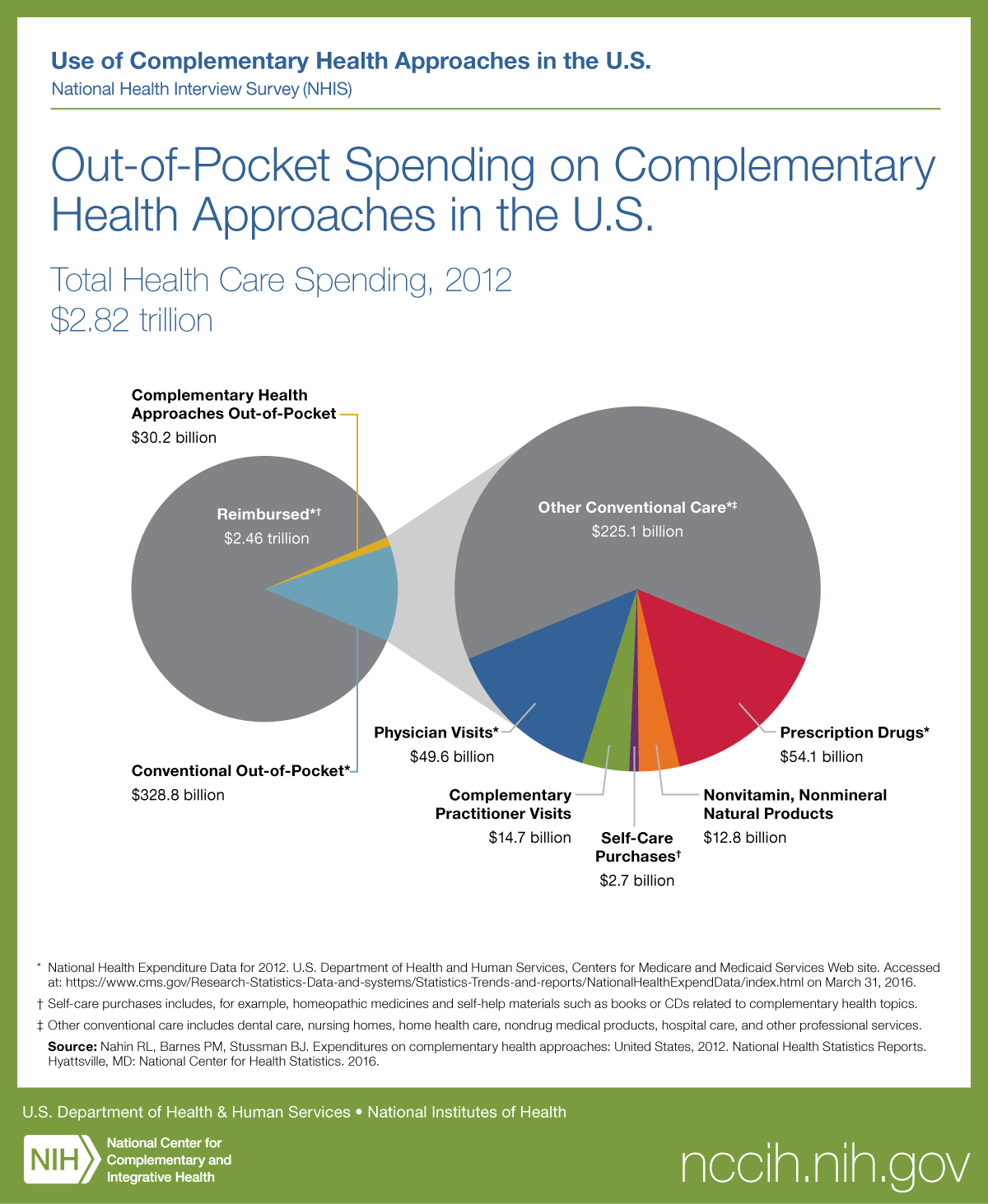
Pie Chart with three parts:
- Reimbursed*†—$2.46 trillion;
- Complementary Health Approaches Out-of-Pocket—$30.2 billion;
- Conventional Out-of-Pocket*—$328.8 billion.
The two parts that are not reimbursed are split into the following:
- Other Conventional Care*‡—$225.1 billion;
- Self-Care Purchases†—$2.7 billion;
- Prescription Drugs*—$54.1 billion;
- Physician Visits*—$49.6 billion;
- Practitioner Visits—$14.7 billion;
- Nonvitamin, Nonmineral Natural Products—$12.8 billion.
* National Health Expenditure Data for 2012. U.S. Department of Health and Human Services, Centers for Medicare and Medicaid Services Web site. Accessed at: www.cms.gov/Research-Statistics-Data-and-systems/Statistics-Trends-and-r… on March 31, 2016.
† Self-care purchases includes, for example, homeopathic medicines and self-help materials such as books or CDs related to complementary health topics.
‡ Other conventional care includes dental care, nursing homes, home health care, nondrug medical products, hospital care, and other professional services.
Citation: Nahin RL, Barnes PM, Stussman BJ. Expenditures on complementary health approaches: United States, 2012. (433KB PDF) National Health Statistics Reports. Hyattsville, MD: National Center for Health Statistics. 2016.